
On this page…
Foreword
Climate change has been widely recognised as one of the greatest threats to public health of the 21st century. As the biggest employer in this country, the NHS has a significant role to play in helping to tackle this crisis. At CCC we understand both the significant threat that climate change presents to the people in our region and our responsibility to take action.
In 2019 it was estimated that the NHS produced 5.4% of the UK’s greenhouse gas emissions. The NHS has therefore set itself the ambitious target of reaching net zero carbon emissions by 2040.
At CCC we started the work to make ourselves more environmentally sustainable with the publication of our first ever Green Plan in 2022. Our annual reports on the progress against our original Green Plan have demonstrated significant progress, and a summary of our journey so far is included later in the plan.
This refreshed Green Plan for 2025-28 sets out our approach to continuing the success of our sustainability programme over the next three years. Implementing the actions set out in this plan will enable us to make sustainable changes and incremental reductions in our carbon emissions, air pollution and waste over the next three years.
As CCC comes together with the other acute and specialist hospital providers in Liverpool to form the University Hospitals of Liverpool (UHL) Group, there is clear potential for us to work ever more closely with our NHS partners on the sustainability agenda. Coming together as the UHL Group will allow us to make an even bigger strides in reducing our environmental impact over the coming years.
“The world is reaching the tipping point beyond which climate change may become irreversible. If this happens, we risk denying present and future generations the right to a healthy and sustainable planet – the whole of humanity stands to lose”
Kofi Annan, Secretary-General of the UN, 1997-2006
“The greatest threat to our planet is the belief that someone else will save it”Robert Swan, British adventurer
The national picture
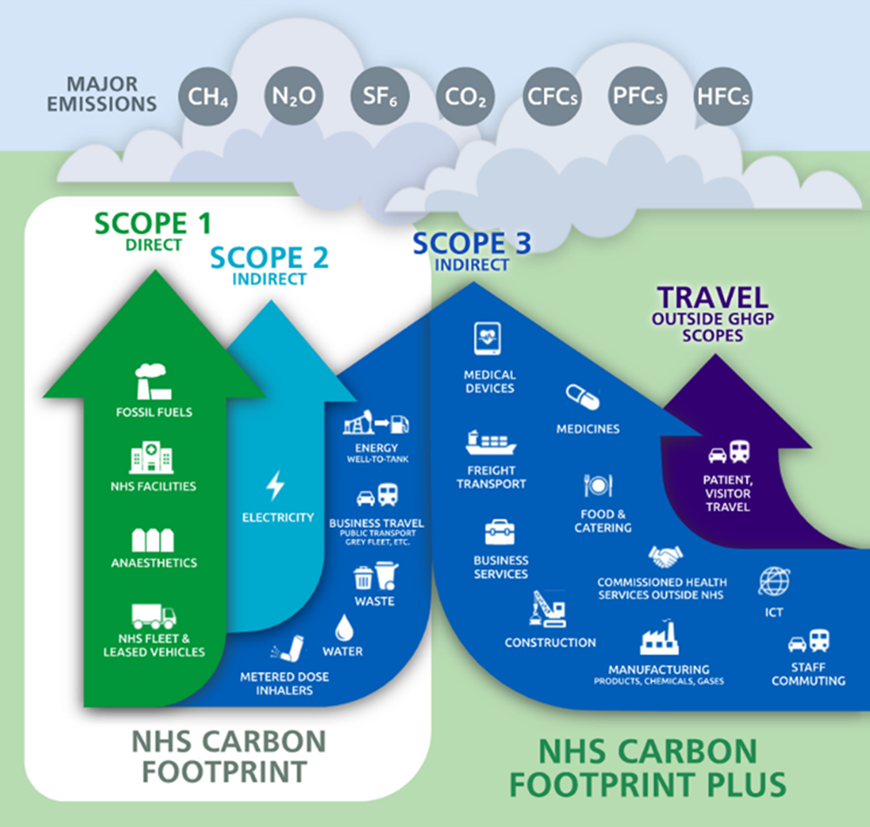
The NHS currently contributes approximately 5% of the UK’s total carbon emissions (around 27 million tonnes of carbon each year). This means that we are a big part of the problem, but also means that we can be a big part of the solution.
In 2020, the NHS became the first healthcare organisation in the world to declare its intentions to reach carbon net zero.
The Delivering A Net Zero National Healthcare Service report sets out two targets for the reduction of emissions:
- To reach net zero by 2040 for the emissions we control directly (NHS Carbon Footprint) - with the ambition of reaching an 80% reduction between 2028 to 2032
- To reach net zero by 2045 for the emissions we can influence (NHS Carbon Footprint Plus) - with the ambition of reaching an 80% reduction between 2036 to 2039
What we can do
Our CCC Green Plan is set out in ten key themes. Here are our ambitions for each of these themes.
Corporate approach
Ensure that sustainability has Board-level support and is embedded as a key consideration and business as usual throughout everything we do at CCC.
Care models
Work with our staff and patients to develop and deliver more efficient and sustainable healthcare.
Workforce
Create a culture of sustainability at CCC and inspire and empower our workforce to play their part in helping us to achieve our net zero ambitions.
Travel and transport
Promote low-carbon travel options for our staff, work towards decarbonising our fleet and reduce the emissions associated with our business mileage.
Energy
Manage and upgrade our buildings to minimise the emissions associated with our energy use and work towards decarbonising our estate by replacing our reliance on fossil fuels with more renewable sources of energy.
Waste and water
Generate less waste, reuse and recycle more, ensure that unavoidable waste is managed in the most sustainable way and increase our water efficiency.
Food, catering and nutrition
Provide high quality, healthy, nutritious and sustainable food options for our patients, staff and visitors and explore innovative ways to reduce our food waste across CCC.
Green spaces and biodiversity
Improve our green spaces in a way that supports biodiversity enhancement, reduces air pollution, captures carbon and enables our local wildlife to thrive.
Suppliers and partners
Ensure that we work with suppliers and partners who are aligned to our sustainability goals and include a weighting for sustainability and social value in procurement processes.
Adaptation
Become ‘climate ready’ by ensuring that our services and estate are fully adapted to deal with the challenges that climate change brings.
Our journey so far
We have already taken significant steps to help us move toward achieving our net zero ambitions, including:
- Produced our first Green Plan in 2022
- Appointed a dedicated Board-level lead and Sustainability Programme Manager to drive forward our green agenda
- Included sustainability as part of the new vacancies and recruitment process (including at induction)
- Hosted our first sustainability work experience student
- Included sustainability courses in our staff prospectus (now shared in a digital-only format)
- Included sustainability as an award category at our annual Staff Excellence Awards
- Established a dedicated multidisciplinary Sustainability Action Group
- Launched our “gloves-off campaign” helping to raise awareness of, and reduce inappropriate glove use across CCC
- Made the switch to reusable theatre caps
- Worked to quantify the carbon emissions associated with our proton therapy service (the first project of its kind in the UK)
- Established our first Green Champions Network group
- Made the switch to Ecosia as our default search engine
- Published our first “Green Travel Plan” in 2023
- Introduced incentives to support our staff to make a greener commute to work (bike to work scheme, free rail tickets, EV charging at or near our sites, public transport season ticket loan scheme, free bike maintenance sessions)
- Launched a maintenance and refurbishment programme at CCC-W, including improvements to building efficiency (roofing, windows, doors and insulation upgrades)
- Developed and optimised our Building Management System at CCC-L
- Made the switch to LED lighting across all sites
- Established our first “Energy and Sustainability” working group
- Supported a staff-led reusable drinking bottle initiative in radiotherapy
- Worked with students from Wirral Met College to produce bird boxes and bug hotels for our CCC-W site and engaged with Wirral Barn Owl conservation to install an owl box on-site
- Arranged an on-site ecology survey to be conducted at CCC-W to identify further opportunities for biodiversity enhancement
- Introduced protected “no mow” areas at our CCC-A and CCC-W sites
- Introduced recyclable packaging and cutlery at our on-site café at CCC-L
- Nominated two named Adaptation Leads for CCC
Corporate approach
What we want to do
Ensure that sustainability has Board-level support and is embedded as a key consideration and business as usual throughout everything we do at CCC.
How we will do it
- Embed sustainability and climate emergency action into the culture of CCC
- Work ever more closely with our partners as we come together as the University Hospitals of Liverpool (UHL) Group to maximise our collective impact on environmental sustainability
- Quantify and report our carbon emissions at regular intervals to demonstrate programme progress
- Empower our colleagues to embed sustainability as a key consideration in their work areas
- Upskill our workforce by encouraging training related to this subject and ensuring that colleagues have capacity to address the climate emergency within their role
- Introduce environmental and sustainability criteria into procurement processes and proposals for service development alongside a focus on cost and availability
- Communicate our Green Plan to patients, visitors and the local community via our external-facing website and relevant channels
- Have the appropriate governance processes in place to support the sustainability agenda and providing regular updates on programme performance at Board-level
How we will measure it
Reduction in carbon emissions across all areas of CCC, captured by regular carbon reporting
Percentage of staff completing sustainability training.
“It is absurd to question whether we can afford to keep our planet liveable”
Fiona Harvey, environmental journalist
Care models
What we want to do
Work with our staff and patients to develop and deliver more efficient and sustainable healthcare.
How we will do it
- Identify a clinical lead for sustainability and develop a clinical working group to target areas of opportunity and enable shared learning and best practice
- Seek to review and optimise the care that we deliver with a focus on developing and providing more low-carbon care pathways
- Incorporate the sustainable use of resources and consumables into our care models and include this as a decision criteria when developing care pathways
- Support quality improvement projects in clinical areas that focus on a measurable reduction in carbon emissions
- Continue to identify an optimal balance between in-person care and telemedicine, making use of remote monitoring where appropriate
- Continue to utilise the most environmentally sustainable options for our anaesthetic gas use
- Calculate the environmental impact of specific care models to identify the most effective ways of minimising our carbon footprint
- Seek the views of patients, staff and local partners to improve services in a way that reduces our environmental impact
- Ensure that when major medical equipment is replaced we are opting for more sustainable alternatives
How we will measure it
- Assess the number of quality improvement projects that incorporate an element of sustainability or carbon reduction
- Report on the quantity of in-person and telemedicine appointments taking place
- Continue to monitor our anaesthetic gas use
- Begin to explore the impact of our use of medicines, and their associated emissions
“Medicines account for 25% of emissions within the NHS”
Delivering a Net Zero NHS
“Given the global health imperatives, the NHS must stick to its net zero ambitions. There is no trade-off between climate responsibilities and reducing waiting lists.”
Professor Lord Darzi of Denham
Workforce
What we want to do
Create a culture of sustainability at CCC and inspire and empower our workforce to play their part in helping us to achieve our net zero ambitions.
With approximately 1,900 members of staff, our workforce are one of the greatest assets that we have at CCC with regards to bringing about sustainable change. Our ambition is to harness the enthusiasm and support of colleagues from across CCC to drive the implementation of our sustainable actions and reduce our carbon footprint.
How we will do it
- Encourage, invest in and upskill our workforce to drive and implement staff-generated sustainability initiatives across CCC
- Keep staff members updated on our sustainability work via our communications channels to ensure that colleagues understand the role that they can play with regards to tackling climate change
- Encourage our green network champions to complete the Greener NHS programme's “Building a Net Zero NHS” course
- Launch of staff-wide behaviour change campaigns (including an energy saving initiative)
- Support our workforce to digitise more of their paper processes (Workforce & OD, Pharmacy, Research and Innovation)
- Recognise and acknowledge staff who champion sustainability initiatives within their work areas
- Explore options for obtaining colleague’s views and opinions of the wider sustainability agenda through staff surveys
How we will measure it
- Number of CCC Green Network Champions
- Number of sustainability projects generated by staff members
- Measuring the carbon impact of behaviour change campaigns
- Number of processes that have been digitised
“No one can do everything, but everyone can do something”
Max Lucado, author
Travel and transport
What we want to do
Promote low-carbon travel options for our staff, work towards decarbonising our fleet and reduce the emissions associated with our business mileage.
How we will do it
- By 2026 all vehicles offered through our NHS salary sacrifice scheme will be ultra-low or zero-emission vehicles
- Work towards electrifying our small fleet of vehicles by 2032, with the interim goal of 90% of our fleet being low, ultra-low or zero-emission vehicles by 2028
- Ensure that we have an electric vehicle (EV) charging infrastructure available at all sites
- Introduce a structured car-sharing initiative
- Reduce the emissions associated with our business mileage and grey fleet
- Continue to optimise our medicines delivery service, reducing the number of road miles that this accounts for
- Seek to influence planning and investment in public and active travel to meet the needs of our staff and patients
- Continue to encourage our staff to make a greener commute to work and continue to conduct our staff travel surveys at regular intervals
How we will measure it
- Staff travel survey data
- Business mileage and grey fleet data
- Reports from suppliers
- CPL medicines delivery data
- Number of staff participating in specific green travel initiatives
“The NHS fleet is the second largest fleet in the country [after Royal Mail], consisting of over 20,000 vehicles travelling over 460,000,000 miles every year. This fleet, combined with the impact of commissioned services and staff travel, directly contributes to the 36,000 deaths that occur every year from air pollution. This burden is borne disproportionately by those with pre-existing health conditions, older people, and children.”
NHS Net Zero Travel and Transport Strategy
Energy
What we want to do
Manage and upgrade our buildings to minimise the emissions associated with our energy use and work towards decarbonising our estate by replacing our reliance on fossil fuels with more renewable sources of energy.
How we will do it
- Identify and implement further opportunities for reducing our energy consumption
- Explore opportunities for the installation of on-site renewable energy sources including solar panels at CCC-W
- The continuation of major investments in a way that contributes to the reduction of our environmental impact (upgrading doors, glazing, roofs, insulation, external cladding)
- Ensure that new building works and refurbishments conform to low-carbon standards (including the Net Zero Carbon Hospital Standard)
- Produce a heat decarbonisation plan for each of our sites and conduct regular decarbonisation audits
- Upgrade our air conditioning units with more sustainable alternatives
- Installation, development and optimisation of Building Management Systems (BMS) across all of our sites
- Develop and launch a CCC-wide printing policy to improve practices, saving up to 75% of the energy associated with our printing
- Launch an in-house energy saving software solution to power down electronic equipment at specific times, where appropriate
- Collaborate with regional partners and anchor institutions to accelerate energy decarbonisation
How we will measure it
- Energy consumption and BMS data across all sites
- Quantifying the carbon emissions from our energy use (tonnes of co2e)
- Proportion of our energy obtained from renewable sources
- Carbon reduction impacts of behavioural change campaigns
- Printing figures
“Life with dramatically lower energy consumption is inevitable, and it’s better to plan for it than to be taken by surprise”
Rob Hopkins, environmental activist
Waste and water
What we want to do
Generate less waste, reuse and recycle more, ensure that unavoidable waste is managed in the most sustainable way and increase our water efficiency.
How we will do it
- Produce a Sustainable Waste Management Plan for CCC
- Continue to ensure that none of our domestic general waste ends up in landfill
- Introduce food waste and dry mixed recycling segregation and upgrade our waste signage to encourage the correct items to be placed in the correct bins
- Roll out a Waste Champions initiative
- Make the switch to reusable consumables where appropriate (such as sharps bins, tourniquets, gowns, curtains, scissors)
- Define a formal and consistent process for the sustainable disposal of our electronics and electrical equipment waste
- Implement an in-house furniture rehoming scheme
- Improve waste reporting across CCC
- Include water-efficient appliances in building refurbishments
How we will measure it
- Waste generation data and reporting (ERIC & carbon reporting tool)
- Water usage data and emissions
- Regular audits of waste streams
- Number of waste champions recruited
“There is no such thing as ‘away’. When we throw anything away, it must go somewhere”
Annie Leonard, founder of The Story of Stuff
“As one of the largest producers of waste in the country, it is vital that the NHS disposes its waste in a safe, efficient and sustainable manner, and we are only creating waste when absolutely necessary”
NHS Clinical Waste Strategy
Food, catering and nutrition
What we want to do
Provide high quality, healthy, nutritious and sustainable food options for our patients, staff and visitors and explore innovative ways to reduce our food waste.
How we will do it
- Identify opportunities for procuring more seasonal and locally sourced food for our patients, staff and visitors
- Review the recently published NHS recipe bank and identify opportunities for making the switch to healthier, lower-carbon meal options (such as plant-based meals)
- Identify and implement opportunities for more sustainable food packaging across our on-site food providers
- Measure, monitor, minimise and segregate our food waste with the support of the food waste reduction roadmap toolkit and food and drink waste hierarchy
- Explore sharing surplus food with local food banks and charities
- The discontinuation of use of single-use plastics for all items in the catering environment – including plates, cups, covers and lids
- Move away from the use of disposables by exploring opportunities for making the switch to returnable items such as cutlery, cups and takeaway food containers
How we will measure it
- Percentage of our food obtained from local suppliers
- Percentage of low carbon meal options available
- Food waste data
- Volume of surplus food donated
- Number of single-use plastic items used in our catering
“It is important that all healthcare organisations see the intrinsic value in the view of ‘food as medicine’ and that it remains a standing item on the board agenda”
National Standards for healthcare food and drink, 2022
Green spaces and biodiversity
What we want to do
Improve our green spaces in a way that supports biodiversity enhancement, reduces air pollution, captures carbon and enables our local wildlife to thrive.
How we will do it
- Install additional resources to support our local wildlife (bird boxes, bat boxes, bug hotels, owl boxes)
- Plant additional native bulbs and trees across our estate
- Continue to engage with external partners including NHS Forest, Mersey Forest, Biodiversity Wirral, Arbtech, Wirral Barn Owl Conservation, Wirral Met College
- Make improvements to the Winter Garden at CCC-L
- Install additional no mow zones and a wildflower meadow at CCC-W
- Explore opportunities for the introduction of an on-site herbal garden managed by staff volunteers
- Install signage, wayfinding signs and a sustainably-sourced artistic sculpture around the Wirral Glade
- Produce CCC’s first Biodiversity Management Plan
How we will measure it
- Regular green space audits
- Repeat of ecological assessment at specified time points
- Monitor usage of on-site resources to support wildlife (bird boxes, owl box)
“Surely we have a responsibility to leave for future generations a planet that is healthy and habitable by all species”
Sir David Attenborough, broadcaster and naturalist
Suppliers and partners
What we want to do
Ensure that we work with suppliers and partners who are aligned to our sustainability goals and include a weighting for sustainability and social value in procurement processes.
How we will do it
- Source sustainable products and materials and partner with environmentally and ethically conscious suppliers
- Work with procurement colleagues to standardise sustainability criteria for suppliers
- Encourage and support suppliers and partners to go beyond minimum requirements and engage with the Evergreen Sustainable Supplier Assessment to support a single conversation between CCC and our suppliers regarding our sustainability priorities
- Work with suppliers to identify options for reducing plastic items such as packaging
- Monitor new and emerging technologies, innovations and funding opportunities which could support us with our net zero goals
- From April 2027 work with our suppliers to encourage reporting of carbon emissions for all scopes and targets (in line with the Net Zero Supplier Roadmap)
- Continue to maintain links with the sustainability teams of our NHS partners in a bid to align strategies, goals and projects where appropriate
How we will measure it
- Spend data for our consumables
- Proportion of suppliers and partners who have completed the Evergreen assessment
- Proportion of suppliers and partners with a compliant carbon reduction plan
- Proportion of suppliers and partners reporting their carbon emissions and targets from April 2027
“The NHS can reduce emissions from its supply chain in three ways: more efficient use of supplies; low-carbon substitutions and product innovation; and by ensuring our suppliers are decarbonising their own processes”
Delivering a Net Zero NHS
Adaptation
What we want to do
Become ‘climate ready’ by ensuring that our services and estate are fully adapted to deal with the challenges that climate change brings.
How we will do it
- Develop plans to mitigate the risks of climate change on our Estate and services
- Create a contingency plan to ensure our services remain resilient to extreme weather such as heatwaves, storms and flooding
- Work through the Climate Adaptation Framework developed by weADAPT to identify an adaptation maturity rating for CCC, and work towards improving this rating
- Ensure compliance with the NHS core standards for emergency preparedness, resilience and response to support business continuity during adverse weather events
- Review the UK’s Climate Change Committee summary (updated every five years) which outlines climate change risks and opportunities currently facing the UK and continue to monitor the areas of high risk across our sites
- Factor in the effects of climate change when making infrastructure decisions and designing new facilities (including enhancements like improved green spaces, drainage systems and passive cooling solutions)
- Explore training opportunities for our staff relating to dealing with extreme weather events
- Produce a formal CCC Adaptation Plan
How we will measure it
- Maturity rating on Adaptation Framework
- Number of staff who have completed adaptation-related training
Implementing this plan
To successfully implement our Green Plan, it will be vital to have a clear governance structure for accountability and reporting in place. The delivery of this strategy will be led by the Sustainability Programme Manager, with the support of our multi-disciplinary Sustainability Action Group. The Board lead will ensure that resources and leadership support are made available to aid our transition towards net zero.
The Sustainability Action Group will provide assurance to the Board of Directors on progress against the delivery of the Green Plan through Performance Committee. Taken together, our actions will collectively support the delivery of our sustainability objectives and national carbon reduction targets.
Our dedicated Sustainability Action Group consists of representatives from across CCC: Estates, Facilities, Procurement, Digital, Communications, Workforce & Organisational Development, HR and clinical staff members.
In addition to the above, partnership working will be essential for the delivery of this programme. This includes working with our partners as we come together in the UHL Group and we will review our governance arrangements as this happens.
Enablers
Funding and financial mechanisms
The Sustainability Programme Manager will work closely with Estates and Facilities colleagues to identify, apply for, and secure external funding and grants to aid us in our sustainability efforts over the following years (such as Public Sector Decarbonisation Funding, Low Carbon Skills Fund, community funding, and National Energy Efficiency Funding).
Communications and engagement
We will continue to work closely with our communications colleagues to share updates from the sustainability programme, with information on how our staff can support us even further to achieve our net zero ambitions.
Research and innovation
We will work closely with our Research and Innovation colleagues to identify and explore opportunities for collaboration in this area.
Governance and reporting
We recognise the urgent requirement for action on climate change and will monitor our performance against the targets that we have outlined in this Green Plan.
We will work to develop key sustainability metrics to ensure that we can continually monitor and report on our progress to our senior leaders and other stakeholders. These metrics will align to our strategic ambitions and will include:
- The quantity of co2 savings per project
- Absolute carbon emissions
The information provided by these metrics will provide the basis for regular progress reviews to the Board and to the Greener NHS programme, as well as annual reporting against our strategic objectives and targets.
We will continue to monitor our emissions against these targets and publish our progress on a yearly basis via our Green Plan Annual Report.
What you can do to help
We need every single staff member at CCC to play their part in tackling the global climate emergency. Here are ten ways that you can make a difference at work:
- Complete the free half-hour “Building a Net Zero NHS” course
- Commit to making a greener commute at least once a week (public transport, car sharing, active travel)
- Become a CCC Green Network Champion (and identify and implement sustainability projects within your work area)
- Switch off your lights, monitors, heating at the end of the day
- Commit to at least one meat-free lunch per week
- Put the correct items in the correct bins (and make sure sharps containers are filled to the appropriate level)
- Spend time enjoying the green spaces around our hospital sites
- Think before you print and email
- Avoid unnecessary travel by keeping meetings virtual where possible
- Have a conversation with a colleague about sustainability and our role in tackling the climate crisis
Every single decision to act more sustainably matters, and we can’t do this without you.
Timeline
- 2025 – develop and launch a CCC Green Champions Network
- 2025 – introduce a formal car-sharing initiative
- 2026 – launch a staff-wide behavioural change campaign focussing on energy awareness
- 2026 – all vehicles offered through salary sacrifice will be ultra-low or zero-emission vehicles
- 2027 – empower our clinicians to make sustainability-related improvements to their models of care
- 2027 – seek the views of patients, staff and local partners to improve services in a way that reduces our environmental impact
- 2028 – convert 90% of our fleet to low, ultra-low and zero-emission vehicles
- 2029 – begin to investigate innovative opportunities for offsetting unavoidable carbon emissions
- 2030 – only purchase from suppliers and partners who meet or exceed our net zero ambitions
- 2030 – prepare our estate for renewable heating solutions
- 2032 – reduce direct co2 emissions by 80%
- 2035 – 100% of our fleet will be zero-emissions vehicles
- 2039 – reduce indirect co2 emissions by 80%
- 2040 – achieve net zero carbon emissions in our directly controlled scopes
- 2045 – achieve net zero carbon emissions in our indirectly controlled emission scopes
“Anything else you’re interested in is not going to happen if you can’t breathe the air and drink the water. Don’t sit this one out. Do something. You are, by accident of fate, alive at an absolutely critical moment in the history of our planet”
Carl Sagan, American astronomer and scientist
More in this section...
Last updated 25th November 2025